
Australia ranks 21st out of OECD countries, spending 1.79 per cent of GDP on research and development. The average for the group of developed economies is 2.5 per cent.
Loading
The Czech Republic has leapfrogged Australia in recent years, while the United Kingdom, which ranks just behind, has a stated policy to lift its R&D spending to 2.4 per cent of GDP.
A concerted drive from governments and Australian industry to lift investment to at least the OECD average would be a good start, says Science and Technology Australia chief executive Misha Schubert.
“The other countries aren’t making that investment because they think it’s a nice philanthropic gesture,” she said.
“There will be races for industries and jobs … if we can get there first, those jobs and industries will stay onshore.”
The sector wants both major parties to promise a $2.4 billion fund that would drive promising technologies over the line into becoming commercial.
The idea is akin to the medical research future fund set up in 2015, which has grown to $20 billion, that plays a critical role in pushing “nearly there” research such as funding large-scale trials of promising drugs. There is no equivalent government support for wider science and technology research, such as clean energy, artificial intelligence and quantum computing.
Mr Taylor said the point of the government’s approach was to give industry incentives to drive new technologies and cut emissions.
“The traditional approach to a carbon tax or an emissions trading scheme is to impose penalties: penalise the activities you don’t like. This is a very different approach,” he said.
But new modelling done by the Greens to mark the 10th anniversary of carbon pricing legislation shows if the Coalition hadn’t scrapped the Gillard-era scheme, Australia would have already achieved a 26 per cent reduction in emissions.
Loading
The government’s official target remains a 26-28 per cent cut on 2005 emissions by 2030, although its new plan projects actual cuts could be as much as 35 per cent.
Greens leader Adam Bandt says the modelling shows Australia would have achieved that by 2020, a decade early, if the carbon price hadn’t been dumped.
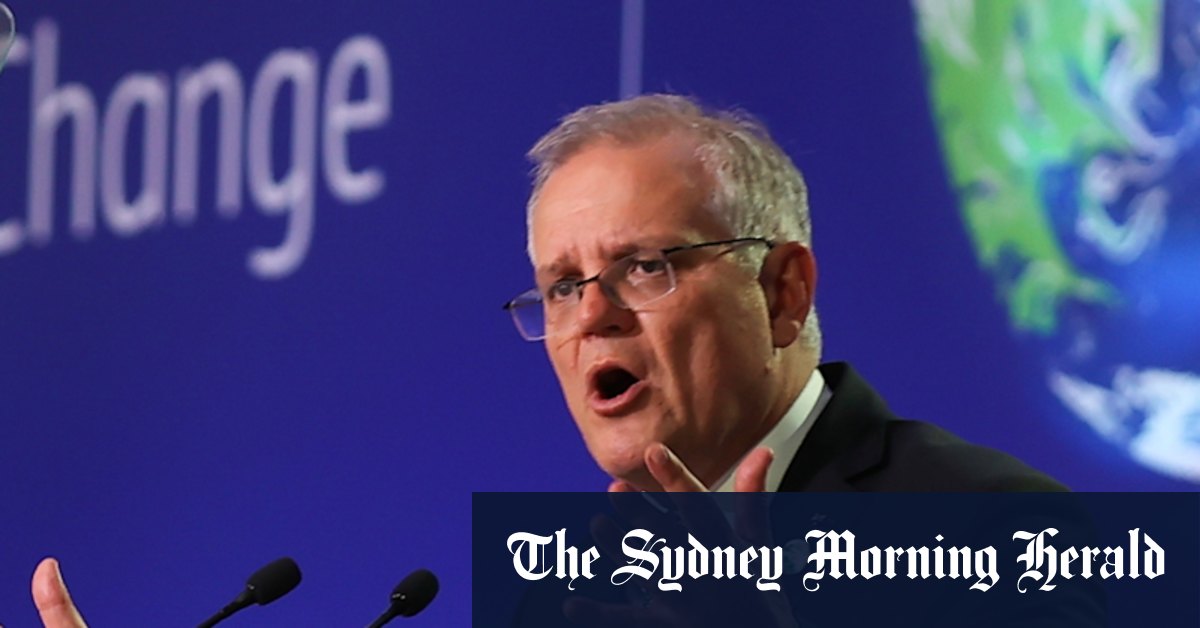
“We would not face, as a country, the humiliation and shame on the international stage Scott Morrison inflicted on us these past weeks,” he will say in a speech to the Green Institute on Monday.
“We would be able to honestly and credibly say we are doing a fair share of what needs to be done to keep people safe.”
Opposition climate spokesman Chris Bowen again ruled out Labor reintroducing a carbon price but left the door open to expanding the existing safeguards mechanism that could be used to stop industrial emissions rising.
The Business Council of Australia called for the mechanism to be used to drive emissions reductions by 2050.
Mr Bowen labelled this a “useful contribution”.
“We’ve announced several policies … and we are continuing to develop more which we’ll announce in due course,” he told ABC’s Insiders program.
The Morning Edition newsletter is our guide to the day’s most important and interesting stories, analysis and insights. Sign up here.
Australia needs to lift its game on R&D spending to reach net zero
Source: Philippines Alive


