
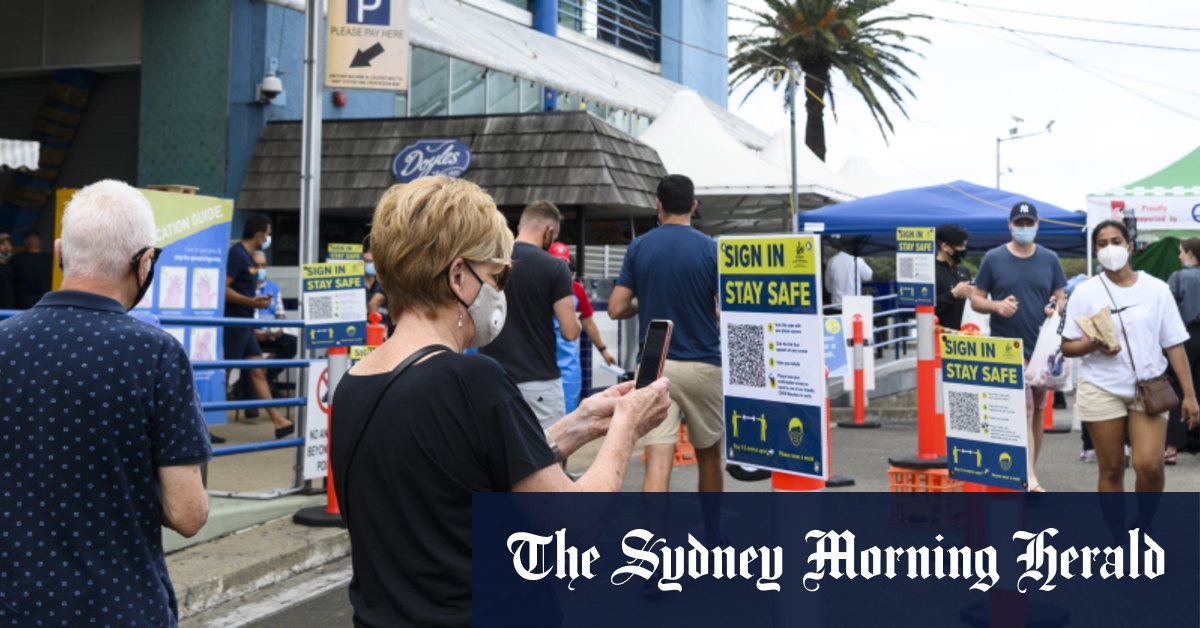
NSW recorded 5612 new cases on Friday, with more than 2000 infections in the Sydney and south-east Sydney local health districts, which stretch from Sutherland to Woollahra.
Loading
NSW Premier Dominic Perrottet announced on Thursday the reintroduction of some restrictions, including compulsory mask-wearing indoors and density limits for pubs.
Under the expanded rollout, more than 2.6 million people in NSW will be eligible for a booster in early January. But pharmacists and general practitioners say exhaustion coupled with the Christmas and holiday rush is putting immense pressure on a workforce struggling to keep up with demand.
“Pharmacists are doing their best and bending over backwards because they’re responding to the public, but for community pharmacies this is probably his busiest time of year,” NSW branch president of the Pharmacy Guild David Heffernan said.
Almost 2 million Australians have now had their booster shot (1,984,415), including 148,783 boosters administered on Thursday.
Chief Medical Officer Paul Kelly said that while protection does not completely disappear from the first two doses of the vaccine, it does wane over time.
“But I will stress that just because you get to three months or four months or five months or six months, it doesn’t mean that you immediately just that day lose your protection.
“[But] it does decrease over time. It remains in place for severe infection, but it is diminished for Omicron compared with Delta,” Professor Kelly said.
The federal government this week announced an increase to booster payments for GPs and pharmacists by $10, while also asking states to accelerate their contribution to the booster program by reinstating closed hubs to get to a target of up to 360,000 daily doses administered across the country.
Hospitalisations in NSW increased to 382 on Friday, up from 215 compared with the same time last week. Fifty-three patients are being treated in the state’s intensive care units, an increase from 24 last Friday. But hospital admissions in NSW remain well below the 1266 peak during the height of the state’s Delta wave.
NSW Health reported one death on Friday, a fully vaccinated woman in her 90s from south western Sydney, who died at St George Hospital. She was a resident of the St Basil’s Aged Care facility in Lakemba, where she acquired her infection.
Data released by London’s Imperial College earlier this week showed patients with the Omicron variant are 40 to 45 per cent less likely to be hospitalised than patients with the Delta variant, and data from South Africa released on Wednesday found people infected with the new strain are 80 per cent less likely to be admitted to hospital.
Omicron accounts for about 80 per cent of all cases in NSW, Dr Chant said on Thursday, and roughly one third of COVID-19 infections recorded in the past three weeks have been in people aged in their 20s.
Dr Chant said Omicron is likely to be milder than previous strains, with the risk of hospitalisation being around 60 per cent to 80 per cent lower than Delta.
NSW recorded 164,144 tests in the 24 hours to 8pm on Thursday, the second-highest tally of daily swabs collected during the pandemic. After pre-travel testing swamped the Sydney’s testing clinics this week, NSW Health is asking people to only get swabbed if they have symptoms or are close contacts.
Professor Tony Cunningham, an infectious diseases physician at the Westmead Institute for Medical Research, said it was critical boosters be prioritised for the elderly, people who are immunocompromised and those with underlying health conditions.
“It is the prudent decision to bring forward boosters to four months. Two doses doesn’t protect as well as with three, and, combined with restrictions, should help bottle up Omicron,” Professor Cunningham said.
With Craig Butt
The Morning Edition newsletter is our guide to the day’s most important and interesting stories, analysis and insights. Sign up here.
Australia surpasses 9000 new daily COVID-19 cases for first time as booster program fast-tracked
Source: Philippines Alive


