
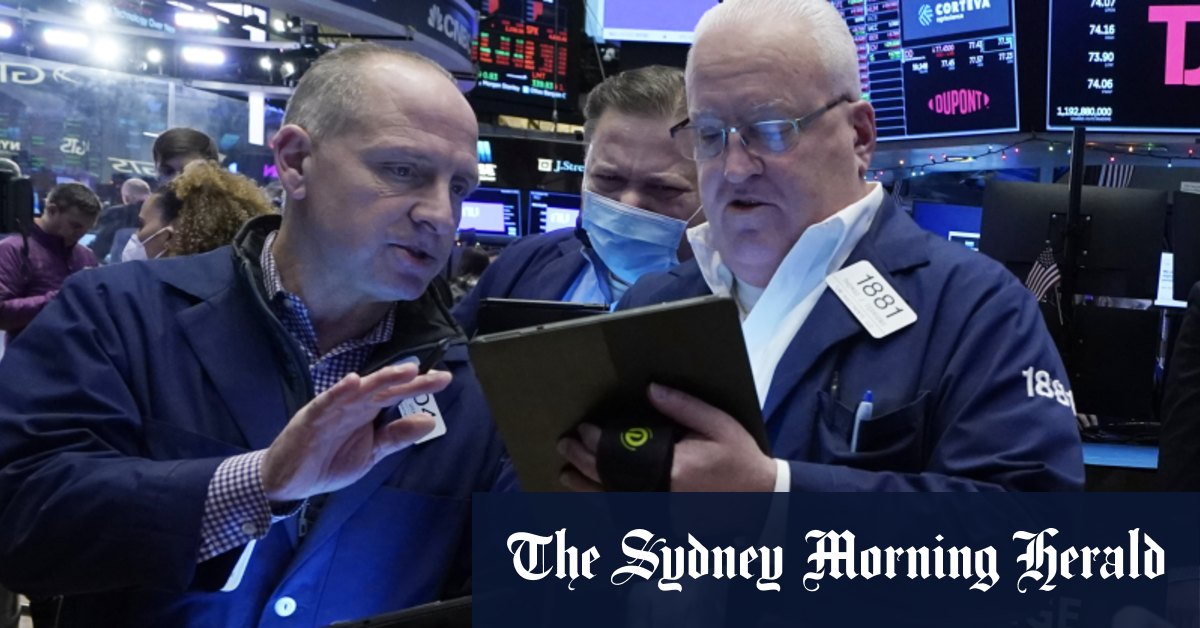
Such concerns helped drag stocks sharply lower in the early going, though the indexes pared their losses by the end of the day. The S&P 500 fell 34.62 points to 4,328.87, and is now down just under 10 per cent from its record set early this year.
The Dow, which slid initially more than 500 points, ended down 179.86 points to 33,614.80. The Nasdaq fell 224.50 points to 13,313.44.
Smaller company stocks also fell. The Russell 2000 index dropped 31.51 points, or 1.6 per cent, to 2,000.90.
In the benchmark S&P 500, more than 60 per cent of stocks fell, with technology and financial companies weighing down the index the most. Apple fell 1.8 per cent and JPMorgan Chase slid 2.8 per cent. Among the gainers were utilities, health care stocks and companies that can benefit from higher oil prices. Occidental Petroleum vaulted 17.6 per cent for the biggest gain in the index.
In Europe, whose economy is much more closely tied to the conflict because of its dependence on oil and natural gas from the region, the losses were sharper. France’s CAC 40 fell 5 per cent, Germany’s DAX lost 4.4 per cent and the FTSE 100 in London fell 3.5 per cent.
Russian forces gained ground, shelling Europe’s largest nuclear power plant and causing a fire early Friday as they pressed their attack on a crucial energy-producing Ukrainian city. Authorities said the blaze was safely extinguished. US Energy Secretary Jennifer Granholm tweeted that the Zaporizhzhia plant’s reactors were protected by robust containment structures and were being safely shut down.
Trading on the Moscow exchange, after briefly opening Monday, has remained closed throughout the week. The value of Russia’s rouble continues to hover below a penny after plunging roughly 30 per cent since the middle of last week. It now takes roughly 104 roubles to get a dollar, up from fewer than 75 at the start of the year. The rouble has dropped as Western governments imposed sanctions that cut off much of Russia’s access to the global financial system.
The price of US oil jumped 7.4 per cent to $US115.68 per barrel, the highest since August 2008. In July of that year, the price per barrel of US crude climbed to an all-time high $US145.29, pushing up the average price for gasoline above $US4 a gallon.
Brent crude, the international standard, climbed 6.9 per cent to $US118.11 per barrel Friday.
“I don’t think the elevated commodity prices are behind us by any means,” said Megan Horneman, chief investment officer at Verdence Capital Advisors. “As energy prices continue to rise, eventually there could be some demand destruction that will result in some peaking in the price and possibly some decline in the price of oil.”
Amid the rush to safety, the yield on the 10-year Treasury fell to 1.74 per cent from 1.84 per cent late Thursday, a big move. It’s well below the 2 per cent level it had reached last month, as expectations built for upcoming hikes in interest rates by the Federal Reserve to rein in inflation.
Loading
Stocks had rallied in the middle of the week after Federal Reserve Chair Jerome Powell said he favoured a more modest increase to interest rates later this month than some investors had feared. The Fed is set to raise rates for the first time since 2018, though it has a tightrope walk ahead because too-high rates can choke the economy and cause a recession.
Powell warned Thursday that the fighting in Ukraine is likely to further magnify the high inflation troubling world economies. Russia is a key oil producer and prices have been rising as global supplies are threatened by the conflict.
AP
ASX set for gains despite Wall Street slide
Source: Philippines Alive


