
Loading
“The French hated it,” wrote one military historian, “because they could not reply to it… Shrapnel, in fact, had a great deal more to do with beating the French than he receives credit for.”
Shrapnel’s invention, however, was liable to explode accidentally or prematurely through friction, Major Hastings said.
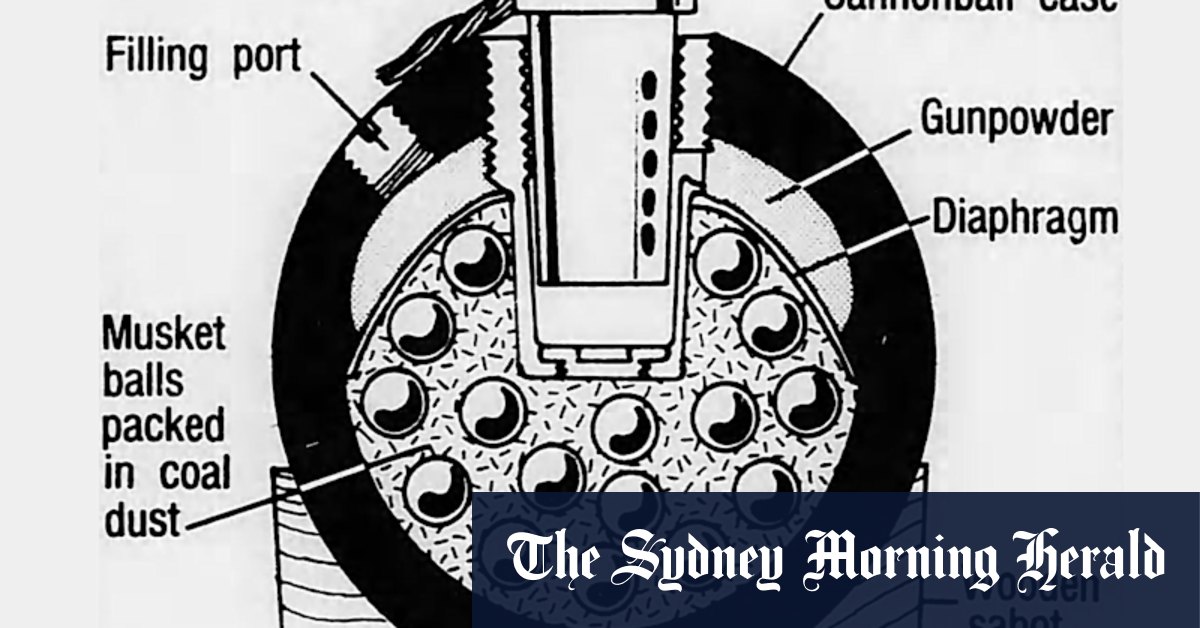
Eventually, Captain E. M. Boxer, devised a shell in which the charge was enclosed in a tube and thus kept apart from the bullets, which were packed in coal dust.
In 1840 he improved on this by separating the bursting charge and the bullets with an iron diaphragm. It was this type of shell that Mr Crump, 78, kept in his home in Burke Road, Glen Iris, for 50 years.
“Somebody had a go at Mr Crump’s shell before we did,” Major Hastings said. “Whoever it was had removed some of the powder, but there was enough still left to make the shell function through a fire or a hard knock.”
Loading
Major Hastings’s team took almost two weeks to examine the shell, which Mr Crump thinks he found in his grandfather’s effects in Hobart in 1854. His grandfather had migrated from England in 1854.
X-rays proved fruitless, and the shell was sent to a country base with the instruction that nobody trying to open it was to be placed at risk.
Now that it has been made safe, the shell is being returned to Mr Crump.
“This was an exceptional case,” Major Hastings said. “We cannot offer this to everybody, but we did so this time because the Crump family seemed to doubt that there was any danger and were a little incredulous that we would take the normal course sad blow it up.”
From the Archives, 1984: Army defuses doorstop crisis for bomb owner
Source: Philippines Alive


