
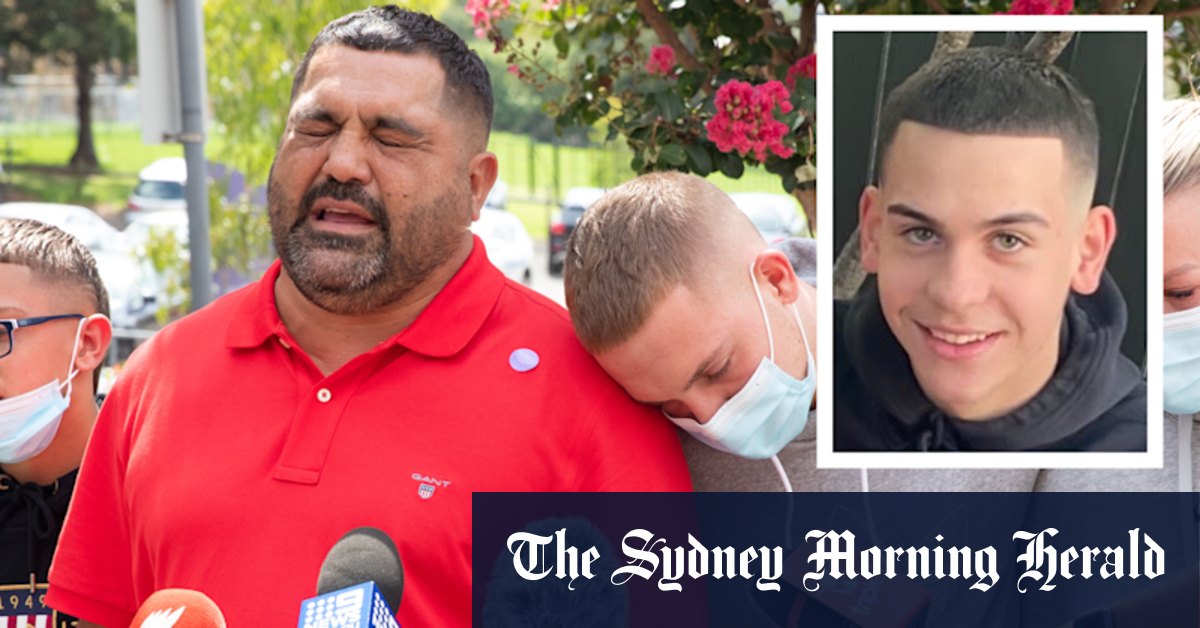
“I just want the truth, as long as I know the complete truth then I will be happy,” Mr Wright said.
Mr Wright also said he was frustrated by his family’s treatment by police after the incident, as they waited in hospital with Jai while he was in a coma.
“I think having a couple of armed police just around the corner from where us, the family, were in the hospital … I felt it was a little bit intimidating, I don’t know whether it was intimidating or I just felt uncomfortable, maybe that’s a better word,” he said.
However, Mr Wright did praise the initial response.
“I appreciated the initial interaction with the commissioner from Redfern, I thought he was quite genuine … I was fine with that because I know we have to have some kind of interaction because of what happened,” he said.
The CEO of Sydney’s Metropolitan Local Aboriginal Land Council, Nathan Moran, said Jai’s death was a ‘tragedy’.
Loading
He said it was particularly hard for the local Aboriginal community, as it had reminded them of the death of Thomas ‘TJ’ Hickey in 2004.
“It happened just within a week of that commemorative date, the date where TJ passed,” Mr Moran said.
TJ Hickey died after catapulting off his bike and becoming impaled on a fence in Redfern. His death triggered days of unrest after locals accused police of chasing him.
An inquest cleared police and found TJ’s death to be a “freak accident”, but his family never accepted that finding.
Rugby league player Josh Addo Carr took to social media to compare the incidents, saying “the system failed us again”.
“This is an ongoing tragedy within Aboriginal communities where young Aboriginal people come into contact with either the law or others and lose their lives,” Mr Moran said.
Another Aboriginal person to die after coming into contact with the justice system in recent months was Gordon Copeland, 22, a Gomeroi man who was last seen by police entering a river outside Moree in the state’s north last July.
NSW Police said they saw a car travelling at high speed on the Newell Highway on July 10th, and then later saw Mr Copeland near the same bogged car at the Yarraman Bridge on the Carnarvon Highway.
Police alleged he then ran away from them before entering the Gwydir River. Mr Copeland’s body was found during a search of the river three months later.
Loading
If Jai’s death is investigated as a death in custody, Mr Wright says he might be able to understand how he lost his son.
All deaths in custody in NSW must be investigated by the state coroner.
“This is a 16-year-old boy – to any parents out there you look at your children and 16 is so young, there is so much more life to live … and now that’s all gone, it’s all taken away,” Mr Wright said.
“One day has changed my whole life forever, and my family’s life forever, and I just wonder did it need to happen this way?”
The NSW/ACT Aboriginal Legal Service said it hoped for a coronial inquest, and echoed the demands of Jai’s family for an independent investigation.
The Herald asked NSW Police why Mr Wright was given conflicting information, if it would consider labeling the incident as a pursuit or death in custody, and what its response was to complaints over the presence of officers at the hospital.
A spokeswoman from NSW Police declined to comment, saying that no further information can be provided as it is undergoing a critical incident investigation. The investigation is being conducted internally by police officers from the Sydney City Police Area Command.
Family of boy on trail bike killed in police crash demand answers
Source: Philippines Alive


